
Two definitions of done can both be true
Two people close the same piece of work at different moments and both of them are finished. What separates them is not care and not skill, it is what each one is holding the work up against, and where the signal to stop comes from.
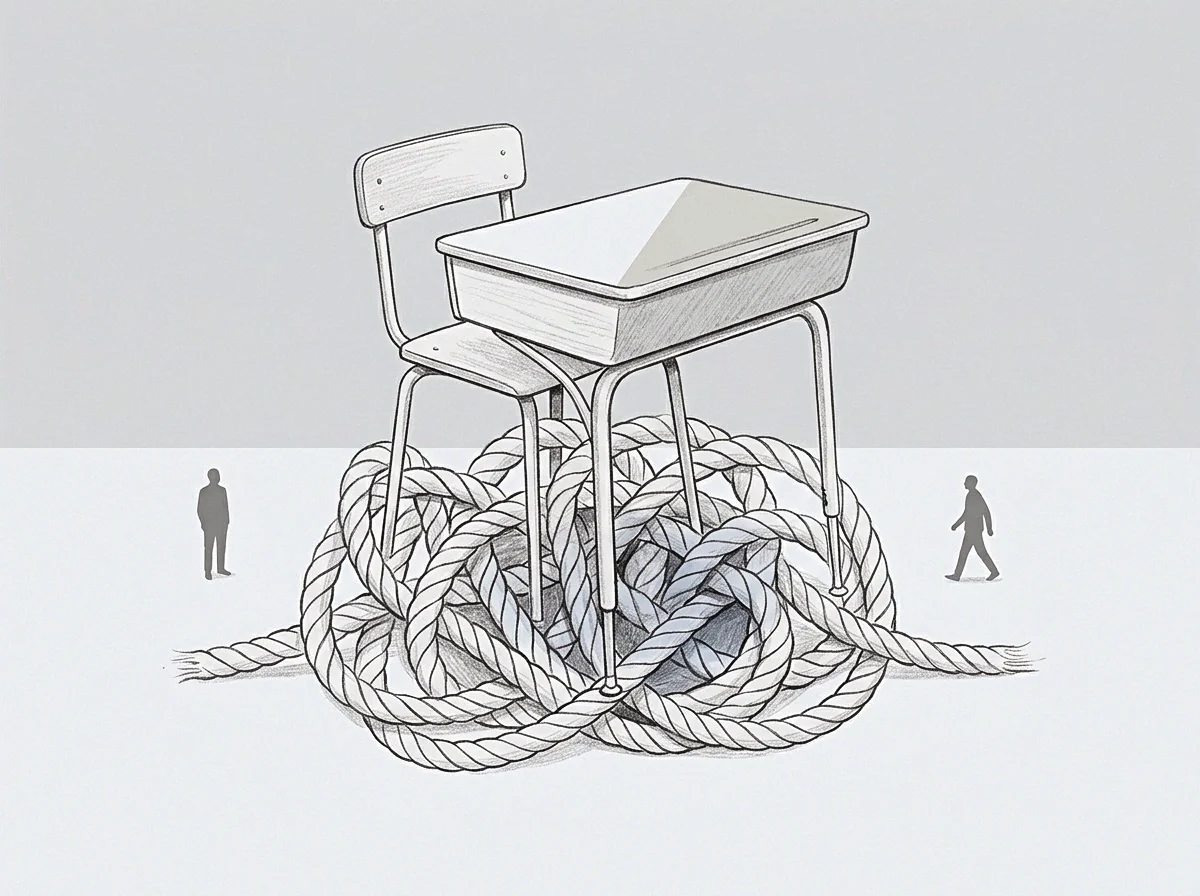
Definition
A second pass needs two things standing before it can happen at all. A person holds both, or holds neither, and from outside the two cases look identical.
The first is something to hold the thing against. A model of the finished thing, carried inside the person and kept apart from what actually came out, so the two can be stood next to each other and the delta read off them. No model, no comparison, no correction.
This is not about effort. Where no separate model exists inside the person, the thing they just made is the model, and a thing held against itself reads as finished every time.
The second is a trigger that starts inside. Nothing out there asks for a second pass. A thing that looks finished puts out no call: it sits on the desk, quiet, and the quiet reads as fine.
So where the action starts outside the person, the second pass never gets its start signal. That is not a refusal. Nobody had anything to refuse.
Put those two conditions in three different places and done comes apart into three separate events. The word stays the same in all three, and it is the only thing that does. What moves is the reading that closes the work, and each of the three closes on something the other two are not measuring at all.
- Done is the delta reading zero. That one is mine, and it makes done a place the loop goes through on its way somewhere, not a wall it stops at. A second pass is not a virtue here, it is the loop still running.
- Done is the handing in. For the partner the completion is the object being made. Opening it again does not improve the work, it takes apart the thing that was actually produced, so a second pass is not neutral inside that seat. It is a loss.
- Done is the hour being over. The acquaintance closes on the appointment ending: the people who paid for it were there, the thing was delivered, it sits behind her now. A second pass would put the acquaintance back into work that nobody is waiting for.
Nothing gets revisited in any of the three, and the reason is different in each.
Two people can agree a date and walk out of the meeting believing they agreed on a definition. They did not. One of them will close the thing when it does what the page says it does, and the other will close it when the box is ticked, and both will be telling the truth when they say it is done.
The argument that comes a week later looks like an argument about standards, and it is not that. Nobody is lowering anything. There is no shared object called done sitting between them for one of them to fall short of.
There are two objects with the same word printed on them, and the word never got opened, because opening it feels like an insult at the moment when everything is still friendly and no work has started.
So the term that goes on the page now is not the date. Done means the thing does what the spec says, read against the spec, by whoever wrote the spec. That one line moves who is allowed to end the work.
With a date, whoever is tired ends it. With a closing condition, the page ends it, and neither party has to be the one telling the other he is not finished.
Artifact
Two objects get made and they are not the same object. One is the thing. The other is the state of the thing having been handed in.
What the Edit Gets Compared Against
The partner takes a single pass over material that takes me several, and I read that difference as care. Care is the wrong mechanism. For a person carrying no separate model, one pass is the whole of the operation: he reads it, he fixes what looks wrong on the surface, and then there is nothing left to do, because there is nothing behind the material to hold it against.
Mine is the material stood next to a finished model of it, whole, which is a slower operation and returns a longer list.
Calling that lazy gets it wrong, and I called it that for years. What reads from my side as a first pass is not the first of anything, it is the whole of production, finished the moment it exists.
The Mark Was the Object
What came back to me carried the mark and not the content. The partner had put the mark on it, and the mark was the work: at the moment it went on, the thing existed and it was finished. The term met inside the arrangement was the mark.
The contents were not part of what got delivered at any point. For a long time I read that as not caring about detail. It is closer to say the detail sat in a different document from the one the partner was making.
A person without the model cannot see the gap from where they stand. Reading the delta between a first pass and a fifth takes the same instrument that producing the delta takes, so nothing is being ignored. Their instruments do not return it.
And my own passes are invisible from there for the mirror reason: they run behind the finished thing. They see that my stuff works. They do not watch the four passes underneath, so in their picture of how work happens a second pass is not a step at all, because no one has ever shown them one running.
It becomes visible to a person who runs on the outside signal at the point where its absence lands on them as a cost. Not before, and not by anybody describing it.
It is finished, I sent it yesterday.
Threshold
A third engine needs somebody outside the person to say a thing is good enough, and where nobody says it, nothing closes at all.
I ran the wrong instrument on this for a long time. Mastery at one end and wanting to look good at the other, an axis that places a person and predicts nothing about a desk. What sat in front of me was a split, not a level.
A long run of delivered work, every piece on the day it was promised to somebody else, some of it closed in the last hour. The commitments that fail are the ones the acquaintance wrote for herself. What a person aims at does not produce that pattern.
Where the starting signal lives does.
The instrument that does the job is Self-Determination Theory, and inside it the internalization continuum, worked out by Edward Deci and Richard Ryan. Their claim is one line: motivation is not a quantity a person holds more or less of, it is a location. Ask where the regulation of a behaviour sits and what comes back is not how much drive is in the room, but how much of the rule the person doing the work has made their own.
The field has used the continuum that way since, sorting work motivation by position rather than by strength.
The line runs from a rule sitting wholly outside a person to a rule taken in and lined up with the rest of what that person is. Four positions sit on the outside half of it, and they are worth carrying by name, because two of them look the same from across a table and run in opposite directions.
At the outer end sits external regulation, the least self-determined of the four: a person acts to get something, or to keep something from landing on them, and what holds the behaviour up sits outside them entirely. A date in somebody else’s calendar. People who paid.
Nothing inside has to be got over, because the shape of the arrangement puts out the start signal on its own, and a position that crude is still the one that fires on the day.
Introjected regulation sits next along, and it is where the rule has been taken inside the person without being made theirs. What holds the behaviour up now sits inside, and it is still somebody else’s rule, so it presses on what the person is worth instead of pulling on what they want. Deci and Ryan give it two faces on the surface: worth held on a condition, which pushes a person to act in order to feel worth something, and ego involvement, which pushes a person to act in order to keep that worth propped up.
It makes guilt all day and movement almost none.
Past that the line comes loose from the outside. Identified regulation: the person does the thing out of the importance they hold it to have, so the cause reads as theirs and it runs with nobody standing over it. Integrated regulation is that same thing lined up with the rest of what a person is for, as far along the line as the outside half goes.
The finding that pays is in the second position. A rule taken in and not made the person’s own is not derived from what that person is, and it is carried as pressure, close to being coerced by yourself. It keeps reading as imposed from somewhere else, whatever handwriting it is in.
The theory’s name for that is the perceived locus of causality, a heavy phrase for a plain thing: where the push is felt to come from. With a swallowed rule the push is felt as coming from outside, even when the person wrote it down themselves that morning. So resenting a deadline nobody set but the one holding it is not a contradiction.
It is what the category predicts, and it is why clean outside regulation moves a thing while a swallowed rule produces self-punishment, circling, the promise renewed, and no page.
What it cost me to find that true is the reading I ran before it. A missing second pass I read as not caring. A product of the acquaintance’s own that did not ship I read as not wanting it enough.
Both of those put the fault inside a person, and inside a person is the one place where nothing can be done about it. Where the regulation sits is a fact about an arrangement, and the terms of an arrangement can be changed. I ran the wrong axis for years, on the acquaintance and on the partner and on myself, when what I needed the whole time was one question about where the signal to start comes from.
That is the split I watched, and it is two seats, not two moods. The delivered work sits in the first: a date somebody else holds, people waiting on it, and the closing issued by the delivery itself the moment it is made. The acquaintance’s own product has no date and nobody waiting, so the work goes round.
The material gets restarted, the deadline she wrote herself gets resented, hours of talking about it produce no page.
What made the delivery enough is the thing a product of her own cannot borrow: people paid for the person delivering, so material that reads as one pass is fine where nobody bought the material. Sell the material on its own and it is the whole of the product, standing at the line where a first pass is what any buyer can produce for nothing. What shipped for years is the part that cannot be sold on its own.
What came out of that was a term, and it was asked for plainly: supply the outside pressure, hold the date from outside the person, put the rule back in the position where it fires. The reading under the ask is accurate, and it is the acquaintance’s own. A rule swallowed and not made your own does not move a thing, a clean outside contingency does, and what is being requested is the conversion from the first into the second.
Hold the date over me and I will make it.
Supplying it works, and that is the difficulty in it. What makes the asking hard to turn down is not the danger that it fails, it is that the date would be met. And it leaves the engine sitting exactly where it is: the next one needs me again, and the one after that, and at that point I am not helping with work, I am the part the work runs on, a position with no end date written into it anywhere.
From outside, my own split looks like the acquaintance’s. Client work ships, my own work stalls. The engine underneath is a different one.
What I work on comes out of what I hold as worth doing, the third position on that line, and it is the reason a run of years underground with nobody asking and nobody watching produced a body of work instead of a folder of intentions. A swallowed rule cannot do that: take the audience away and the rule goes with them, because the audience was the whole of the pressure, wearing the person’s own voice. I do not need somebody to tell me a thing is good.
I read the delta myself, and I knew a document was right before anyone had read a page of it. What a client hands me is not a closing, it is a spec, and a spec caps the loop, which is the one operation I cannot run on myself.
So what I gave was a few weeks, with the end said out loud at the start. I supply the conditions, they run that long, and then they stop whether or not the product is out. The stated end is the difference between lending a condition and becoming one.
The rule sits on the asking and not on the person doing the asking: supply the outside closing once and it is yours from then on, because the version that works keeps the other one from ever having to.
Escalation
I took the material out of the arrangement first, and everything else got simpler in one move. A body of prepared material had been sitting inside the arrangement as a claim with no definition attached to it. That is what makes prepared material the expensive object: the claim is real from every seat in the arrangement, and there is no term anywhere saying what closes it.
I did not argue it. I removed it, and the rest of the conversation had one object fewer in it.
The sentence came a week later, and I had it written on the page before it arrived. It is the same sentence in every arrangement where one seat has put hours into a thing and the other is holding the condition that would close it.
The hours are already in it.
That is the sunk-work argument: work already spent offered as the reason to keep the thing, and it is hard to refuse because the work was real. It was real. It was hours out of the partner’s life.
Under the sentence, though, sits the same split: what the partner did on that material was a run of completions, and by that definition each one of them is done and stays done. Against a model of what the material should have been, the same body of it carries one pass and no second, and no arithmetic turns the first reading into the second.
I did not argue against the sentence. An argument against it puts my refusal on the table, and a refusal is the one object in a room that anybody can push on. So what went on the table was the material: nobody in the arrangement had ever run the operations that sit under a body of material like that once it is actually being sold, the exposure of that ran on the arrangement and not on a seat inside it, and a failure would have come out of the standing both seats sell under.
There is nothing in that to push on. Nobody in it has to be wrong. Two definitions of done do not get settled by one of them winning, and they were never going to be.
They stop colliding at the point where each seat says what it is holding on to, and from there the argument has an object in it.
Both definitions were true the whole time and I priced one of them. Years of picking the drafting back up every time the sentence about not being good at it arrived. A great many hours in one place, fewer in the other, and the second pass in all of it was mine, entered nowhere.
Nobody took anything from me. I ran a closing condition that nobody else in the room was running, and I paid the difference in capacity, month after month, while telling myself it was a thing I could still explain to somebody.