
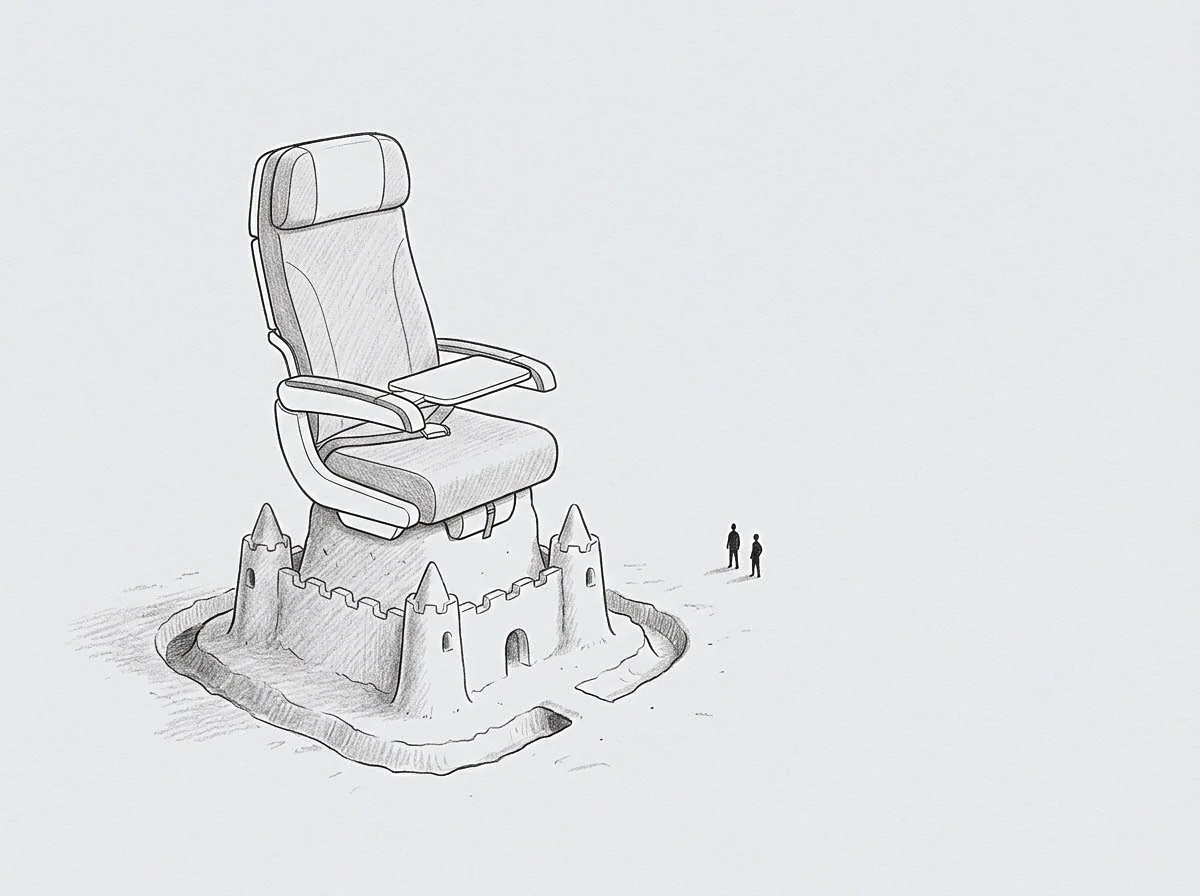
Headroom without introspection
Headroom is not a mood. It is a state variable with a value at every hour, readable off a month without looking inward at all, because when it runs low the tracked deliveries still go out on time and the
A control mechanism determines the maximum number of simultaneous tasks or operations that can execute at any given moment within a system or process. A concurrency limit sets an explicit upper boundary on active work, preventing overload and preserving the stability of critical functions. It governs the capacity for parallel execution, ensuring that resource availability such as processing power, memory, or network bandwidth is not exhausted by an uncontrolled influx of requests or activities.
The application of such a limit stops at the boundary of the governed system, meaning operations external to that system are not directly constrained by its internal ceiling. This mechanism functions as a form of load regulation, allowing a system to prioritize essential workflows during periods of high demand.
This ceiling defines the practical capacity for parallel work, establishing a threshold where new operations are queued or rejected rather than permitted to strain existing resources. A concurrency limit is often implemented to safeguard system performance and prevent cascading failures under heavy load conditions, ensuring a predictable throughput for essential services and maintaining service level objectives. For a founder, setting this limit involves understanding the non-negotiable throughput required for core deliverables and calibrating the ceiling to maintain that performance even at peak demand without over-provisioning.
It is a proactive measure against resource exhaustion, ensuring that fundamental services remain available and responsive despite fluctuating workload volumes, thereby protecting client trust. The ceiling may be fixed based on static resource assessment or dynamically adjusted based on real-time system metrics, reflecting changes in available capacity or perceived load and often incorporating a buffer for unexpected spikes in activity. This dynamic adjustment requires robust monitoring and automation to be effective without constant manual intervention, a setup that carries its own implementation cost.
The design of this operational ceiling inherently involves a trade-off between maximizing resource utilization and guaranteeing service quality, especially for critical operational paths that must never stall or experience significant delay. It represents a boundary against unchecked growth of concurrent operations, preserving the integrity of the work environment. The founder must consider not only technical capacity but also the human capacity required to manage the output of concurrent tasks.
Establishing a concurrency limit directly influences how resources are distributed and consumed across various tasks. By capping simultaneous operations, the system prioritizes existing work over new requests once the threshold is met, implicitly allocating its finite capacity to ongoing processes. This disciplined allocation helps prevent contention for shared resources, which could otherwise lead to performance degradation or outright service interruption for all users reliant on the system.
The founder in the seat must decide which types of work are subject to this constraint and which are exempt, thereby creating an explicit hierarchy of operational importance that reflects business priorities and potential revenue impact. Effective resource allocation through these limits minimizes the energy cost associated with reactive system recovery and allows for predictable performance under defined conditions, ensuring the continuity of revenue-generating activities. This deliberate control over resource flow becomes a core component of system resilience, preventing resource starvation for critical functions.
When a concurrency limit is reached, the system operates at its maximum defined capacity, leading to immediate consequences for subsequent requests or tasks. New operations are typically held in a waiting queue, deferred for later processing, or outright rejected, which can translate into increased latency or service unavailability for clients. For the operator, the cost of saturation appears as a direct impact on user experience, a backlog of non-critical work that accumulates outside the defined limit, or the specific cost in attention required to manage the overflow and communicate delays.
The founder carries the cost in managing client expectations during periods of high demand and in the strategic decision of where to set the limit, balancing immediate responsiveness against the long-term stability of the operational footprint and the capacity of support personnel to handle exceptions. A poorly chosen concurrency limit can result in either underutilized capacity during low periods, leading to inefficient resource expenditure, or persistent service disruptions during peak times, both carrying an opportunity cost in lost revenue or eroded trust and a reputation hit. Understanding these direct and indirect costs informs the iterative refinement of the limit value over time, aiming for an equilibrium that supports growth without compromising stability or incurring excessive operational overhead.
The financial burden of scaling infrastructure prematurely to avoid saturation must be weighed against the commercial cost of declining service quality.
Headroom is not a mood. It is a state variable with a value at every hour, readable off a month without looking inward at all, because when it runs low the tracked deliveries still go out on time and the
The terms are written where they belong. Each field holds three desks, and every entry a desk writes raises the terms it uses, each term given a meaning, a mechanism and the places it appears. The record on these pages stays first person and hand made; the fields grow the nomenclature.