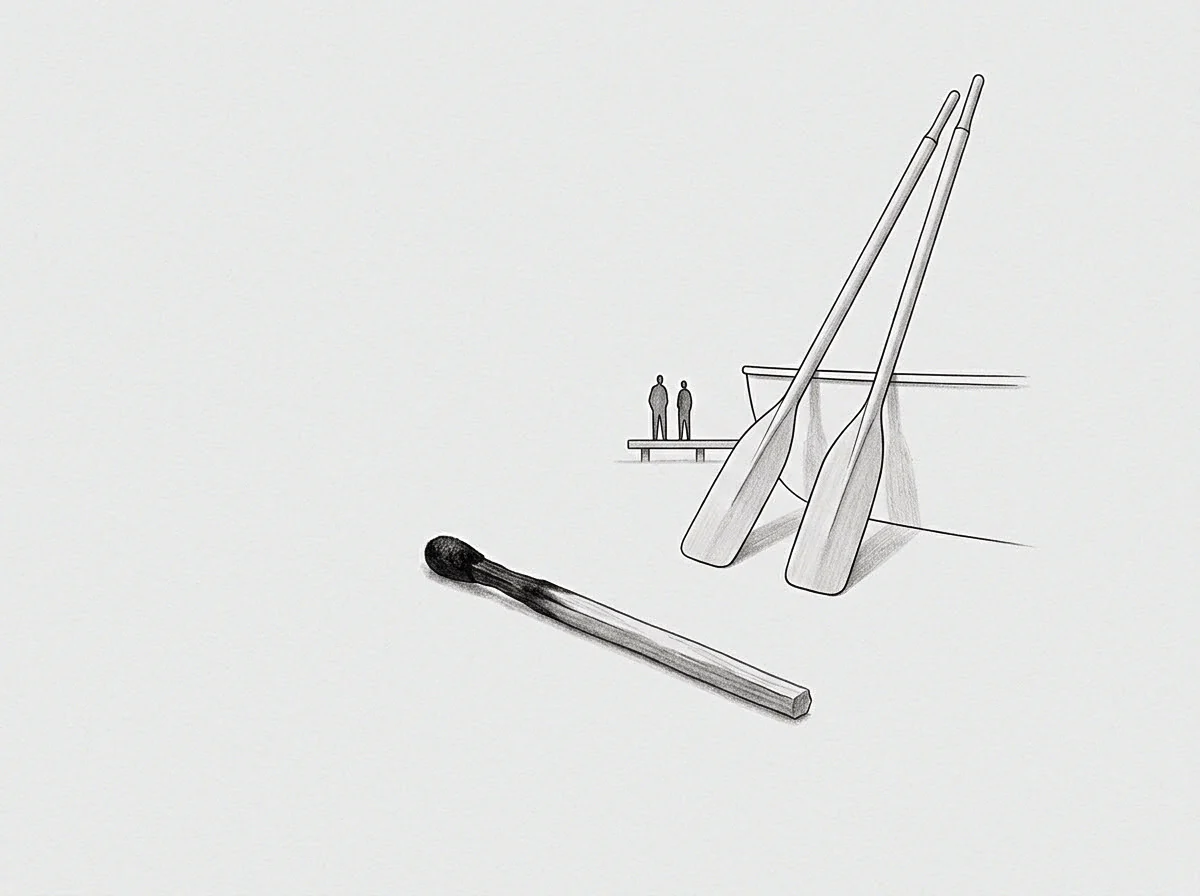
Meaning
A decision characteristic that quantifies the ease or difficulty of reversing a course of action. This reversibility axis indicates how much energy, time, or capital is required to undo a past commitment or change direction. It governs the flexibility inherent in any choice a founder makes, distinguishing between options that permit easy course correction and those that lock in resources or attention.
The axis applies specifically to actions taken and the potential to retract them, rather than to external conditions or static states.
Commitment Cost
Moving along the reversibility axis towards lower undoability directly increases the commitment cost for a founder, making each choice more impactful on future flexibility. This cost is not solely financial; it critically includes the energy and hours invested that cannot be easily reclaimed, representing an opportunity cost for alternative pursuits. For instance, developing a bespoke software solution represents a lower point on the reversibility axis compared to adopting an off-the-shelf product.
Discarding a custom build means losing the development hours, specialized expertise, and the integration effort, effectively writing off a substantial past investment. In contrast, exiting a standard subscription for a software service typically incurs only a cancellation fee or loss of prepayment, leaving most prior investment in time and attention intact. High commitment costs consume a founder’s finite capacity, limiting the operator’s ability to pursue emergent opportunities without incurring further penalties or substantial resource write-offs.
Capacity Load
The position of a decision on the reversibility axis has a direct bearing on a founder’s capacity load. Decisions with low reversibility create a sustained mental burden, demanding continuous attention and reducing the available cognitive space for new challenges. A founder holding a seat carries the weight of past, difficult-to-undo choices, which can lead to attention fragmentation and a sense of constraint.
For example, agreeing to complex, long-term contractual terms with narrow exit clauses places a significant load on the individual responsible for performance, irrespective of immediate financial outlays. This load reduces the capacity available for innovation or response to unforeseen market shifts.
Decision Horizon
The perception of a decision’s reversibility axis often shifts across a founder’s decision horizon, a shift that presents a continuous challenge for resource allocation. What appears easily reversible at an initial stage can become fixed as time progresses or as further resources are allocated, hardening into an unchangeable commitment. Early stages of a project might allow for simple pivots, where the cost of changing course remains low due to minimal resource expenditure.
Yet, after significant investment in infrastructure, specific talent, or the establishment of external partnerships, the cost of reversing becomes prohibitive, essentially locking the operator into a prior choice. Information asymmetry can also obscure the true reversibility of an action, as external observers may underestimate the internal, unquantified costs of undoing an arrangement or disengaging from a relationship. This means that a choice appearing external as a simple ‘queue’ can be an internal ‘position’ that accrues value, making it harder to abandon without visible loss.
This dynamic requires founders to regularly re-evaluate the actual and potential costs of change, moving beyond initial assumptions to account for accumulating commitment and diminishing flexibility, especially when waiting itself incurs a price.