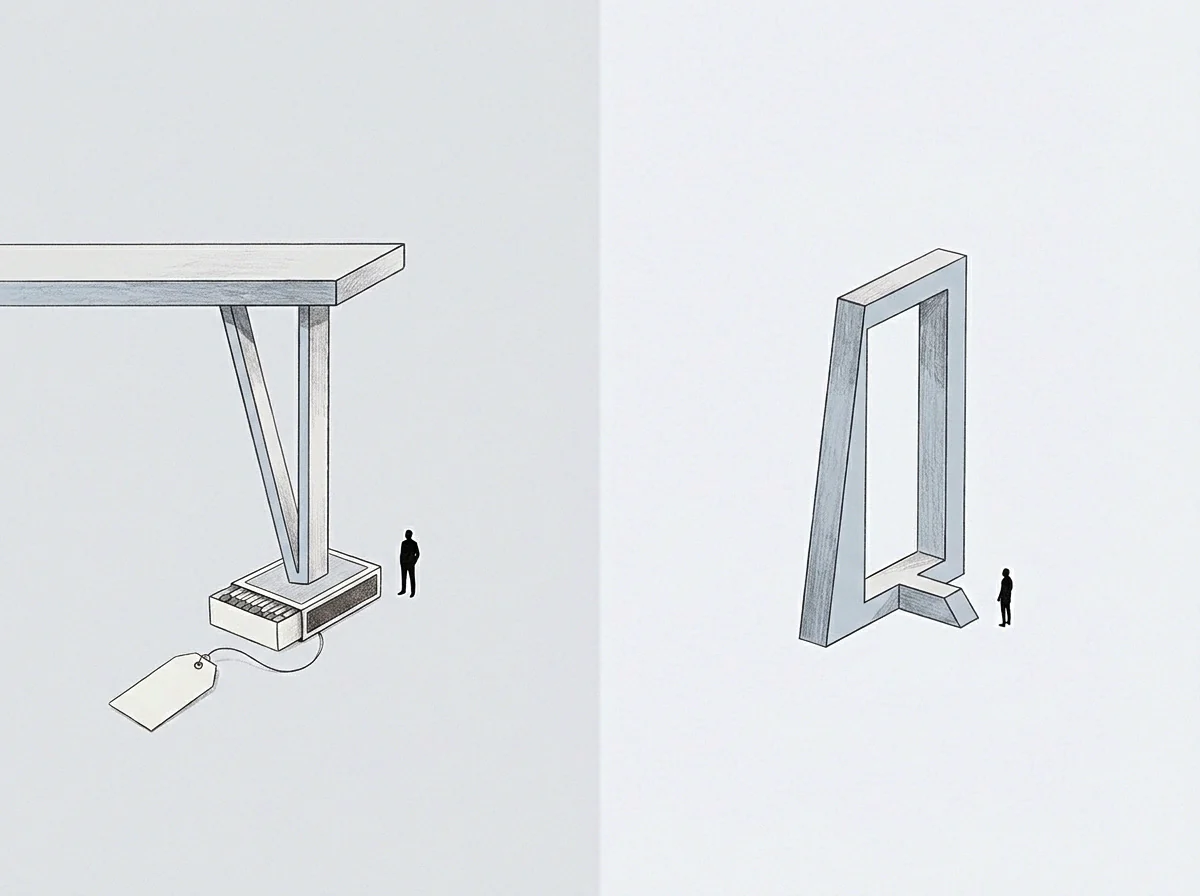
Meaning
A network configuration in which every available communication channel, nodal capacity, and routing path operates at absolute maximum throughput, leaving zero reserve margin for unexpected load. Within an operating team or commercial architecture, a saturated graph describes a state where every participant and process is fully booked with interdependencies, causing any localized delay to trigger immediate system-wide paralysis. The term applies to organizational topology, logistics routing, and software architectures under peak stress.
It stops applying once redundant nodes or spare routing capacity are restored.
Structural Congestion
Operational networks that operate without slack convert minor friction into systemic failure. When every person in an enterprise must coordinate with every other person across a saturated graph, internal communication volume scales quadratically while productive output stalls. Decision velocity collapses because no participant possesses spare cognitive capacity to review or authorize cross-functional handoffs.
The system spends more energy synchronizing its internal state than delivering customer value.
Transmission Friction
Information routing across densely packed nodes suffers from severe latency and message distortion. In a team operating at full saturation, critical operational adjustments are delayed because participants filter messages through overloaded queues. This congestion forces individual operators to make isolated, uncoordinated decisions to bypass the communications bottleneck, ironically causing further graph fragmentation and conflicting priorities.
Capacity Limit
Removing saturation requires either decoupling interdependent nodes or cutting the absolute number of communication vectors. Without deliberate structural pruning, a saturated graph remains perpetually vulnerable to total operational lockdown from minor external volatility.