
Appreciation is not evaluation
Two things get filed under being seen: a person responding to the fact that you made something, and a person able to tell you which part of it works. Only the second one carries information, and I spent years reading a constant as if it were a signal.

Appreciation
Two operations get filed under one word. In the first, a person responds to the fact that you made something. In the second, a person tells you which part of it works and which part does not.
Both feel, from inside, like being seen. Only one of them carries information. I lived on the other one for years and did not know that was what I had.
One vocabulary points at me, and at what the work did to the person looking. It says the thing is impressive, that whoever made it must have something in him, and then it stops.
I do not know how you do it.
The other vocabulary never leaves the object. It goes part by part and says which part holds, then says what should have been standing where the other part is. Same warmth in the room.
Entirely different cargo.
The people around me appreciate. None of them evaluate. It took me years to say that without it sounding like a complaint about people who have been kind to me.
A presence that reacts daily and cannot sort is still worth having: it sits a long way above silence, and silence was the alternative. What it cannot do is read the object. That is the witness function running with the evaluation function missing.
So when an arrangement like that ends, the loss lands on the presence side, where there was something real, and hardly at all on the reading side, where there was never anything to lose. I had those two backwards.
Appreciation is a response to the fact that work happened. Evaluation is a response to what is in the work. Naming the first one correctly changed what I do with it.
I keep it, and I stopped asking it for the thing it was never built to carry.

Evaluation
Evaluation is what a person with the frame already in his head does when he looks at the object and sorts it. It is not encouragement and it is not the opposite of encouragement. It is a reading, and a reading has parts.
When it is missing from a working life the absence stays quiet, because nothing goes wrong on any particular day. It shows up years later as four separate holes, each with its own shape.
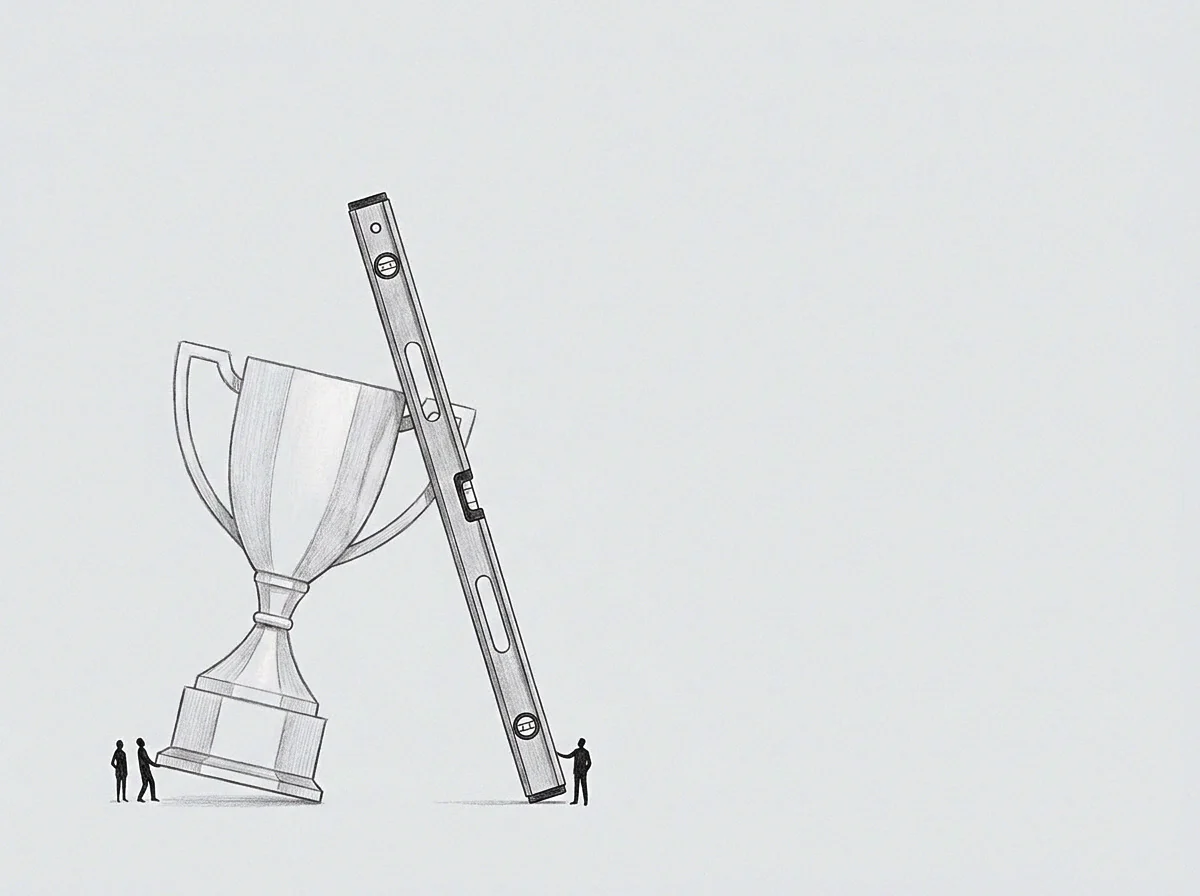
What Nobody Catches
Nobody catches the structure. The client catches output failures, which is the late and expensive place to catch anything, because by then the thing is built and somebody is unhappy with it. A peer catches a design failure early, in the sketch, for free.
I have run for years with no check upstream of my own head, which means every structural mistake I made I also had to find myself, and the way you find a structural mistake yourself is by building the whole thing and living in it for a while.

Where Finished Comes From
With no peer there is no outside definition of finished. A peer can say: ship it, it is fine, you are polishing. Nobody in my circle can say that with standing, because nobody knows what fine looks like for the kind of thing I build.
So the standard stays entirely internal, and an internal standard does one of two things. It drifts upward with nothing to stop it, which is how a site takes years and still does not ship. Or it gets replaced by a forcing function from outside.
Notice which projects ship. The ones with a client attached. Not because I need somebody to make me work, but because the client supplies the definition of done that a peer would otherwise supply, and I have been buying that definition with deadlines for most of my working life.

Calibration and the Ceiling on Ideas
Calibration is the one I understood last. I cannot tell whether a given piece of my work is competent or unusual, because nothing sits beside it to measure it against. I treated my inability to put a price on my own work as a worth problem for years, something downstream of having been shrunk.
Part of it is. Part of it is simply that I hold no outside reference for what my work is worth next to other people doing the same work. A specialist knows the going rate because he knows a room of people doing his job.
I do not have a room, which is another way of saying I have no reference class, and a person with no reference class is not modest or arrogant, he is unmeasured.
The same emptiness caps the input side. Every idea I use is one I derived, by reading, by building, by running the thing until it told me something. That works, and it has a ceiling: a person can only learn what he can conceive of needing.
A peer puts things on your map that were not on it, and there is no substitute for that except accident.
The market is a partial substitute. Revenue evaluates. That is why having it steadied me for years and why losing it took the floor out.
But it evaluates coarsely. It says someone paid. It does not say the structure was right, or that a cleaner approach was sitting next to the one I took, or that I built twice as much as the job needed.
The client is buying an outcome and is not auditing a structure, so what comes back through an invoice is one notch wide: acceptable, or not. That notch is real and I would not give it up. It is also the whole of what a payment carries, and I read it for years as if it carried the rest.
A five-figure fee says the output was acceptable to a buyer and stops there.
The rule I hold now is that a definition of finished which arrives with a deadline is rented from whoever set the deadline.

Sorting
A response that does not change when the work changes is not a response to the work. It is a response to the fact that work keeps arriving. That took me a long time to see, because the two sound identical in a room.
Praise from a person who cannot sort cannot vary, because sorting is the thing that would make it vary. Somebody who cannot tell a sound structure from a sloppy one says the same word to both, so the sentence that comes back for the piece I knew was good and the sentence that comes back for the piece I knew was thin are one sentence:
That is amazing.
I have been receiving a constant. That is not ingratitude on my part. It is arithmetic, and the people saying it were not insincere for a minute.
There is a harder version underneath, and it took me longer. The problem is not that the labour is undervalued. It is that at the level of perception it is not there.
Undervalued: the buyer sees the thing and prices it low, and terms fix that. Imperceptible: there is nothing in front of him to price, and nothing fixes that but changing who is looking.
A large body of work reads, to a person outside the work, as simply large. A thing built fast reads as speed. Neither reading contains the difficulty, and difficulty is where the value sits, because difficulty is what makes a thing hard to reproduce.
Two different problems, two different fixes, and I spent years applying the fix for the first one to the second one.
That is also why describing it does not work. Put the difficulty into words in front of a person who does not hold the frame it lives in, and he hears the words, he nods, he retains nothing, because there is no structure in his head for the description to attach to. Nobody is refusing anything.
The frame is missing at the far end, and a frame cannot be handed over inside the message that needs it to arrive.
Two things transfer difficulty. A peer who already holds the frame, or making the other one do the work himself. Putting the work in front of a person, in a form he has to move through with his own hands, does what years of describing it cannot.
Doing is a channel. Explaining, to a person with no frame for it, is not.
The last piece of it is the one that took the fight out of me, and it is not psychological. If nobody within reach can read the object, the only partnerships on offer are with complements: the person who wants the output and does not need to understand it. That match is real and it works, and it is structurally guaranteed to produce every hole above.
The complement cannot sort the work. He sees the output, not what it cost, and the match never asked him to see more than that.
So the pattern was not only something I did. It was also the correct move in a thin supply, and it would have happened to some degree with nobody’s character involved at all. That matters for the fix.
Terms and pricing correct the extraction. They do not produce a peer, and no amount of work on myself will, because this is a supply problem and not a capability problem, and a supply problem does not answer to effort.
I kept going back to the same people with better and better work, waiting for the response to change. It did not change, because it was never attached to what I made. The years are the cost.
I spent them reading a constant for a signal, and I found out where the work actually stands at an age with less left to do about the answer.