
What representation is worth
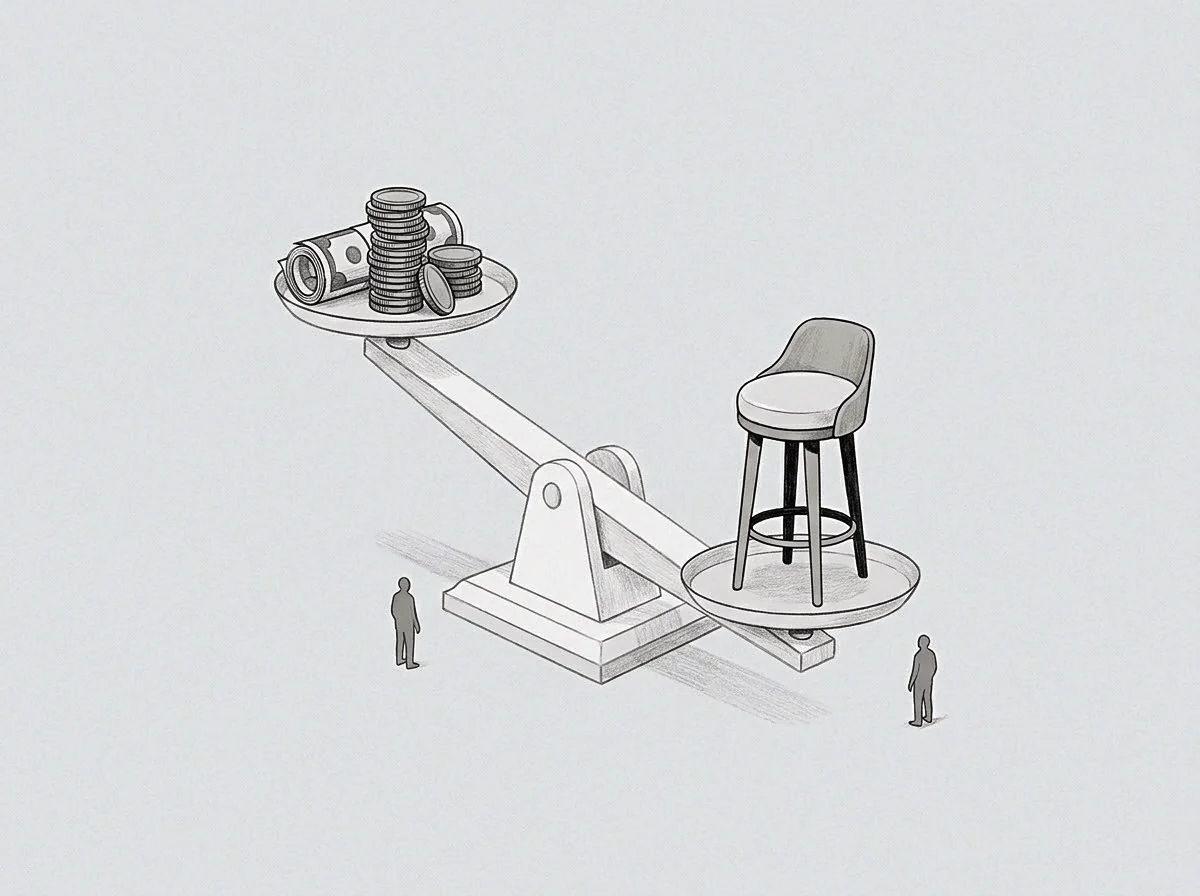
An even split can be an introduction fee wearing a partnership's name. Introductions have a market price, and it is not half. What keeps the difference out of sight for a long time is that one side's contribution is priced and the other's has no entry at all.
Split
The fee comes in and I divide it in two. Half goes to the seat that fronts, half stays with me, and for a long time I did this without looking at it, because that was the arrangement and the arrangement had a name. Partnership.
Two names on the paper, one person producing.
What the fronting seat supplied was the first contact. The seat knew somebody, made the call, sat in the room. Everything sold from that point on I designed, built and delivered: the programme, the materials, the systems under them, the pricing, the terms on paper.
None of it existed without me, so none of it could be sold to anyone unless I was standing behind the seat that sold it. So the transaction was not the one it was called, the seat brings the client, I deliver, the proceeds are shared. The transaction was that a seat arranged access to my capability and kept half of what the capability sold for.
The number was not chosen for that transaction. It was inherited from the first month, when what each side put in was close to equal, and it stayed where it was while the work on one side grew tenfold and the work on the other stayed one phone call. Nobody moved it because nobody was looking at it.
A number that nobody looks at does not stay fair. It stays still. And I was the one doing the dividing.
The cost of a split like this is not the half that leaves. It is the filing. The sale of my capability gets filed under partnership, so anything I ask for gets filed under ingratitude, and I stop asking a long time before I notice I have stopped.
Room
Two things kept the split looking even. Both of them happen in a room, or fail to.

Presence Becomes Partnership
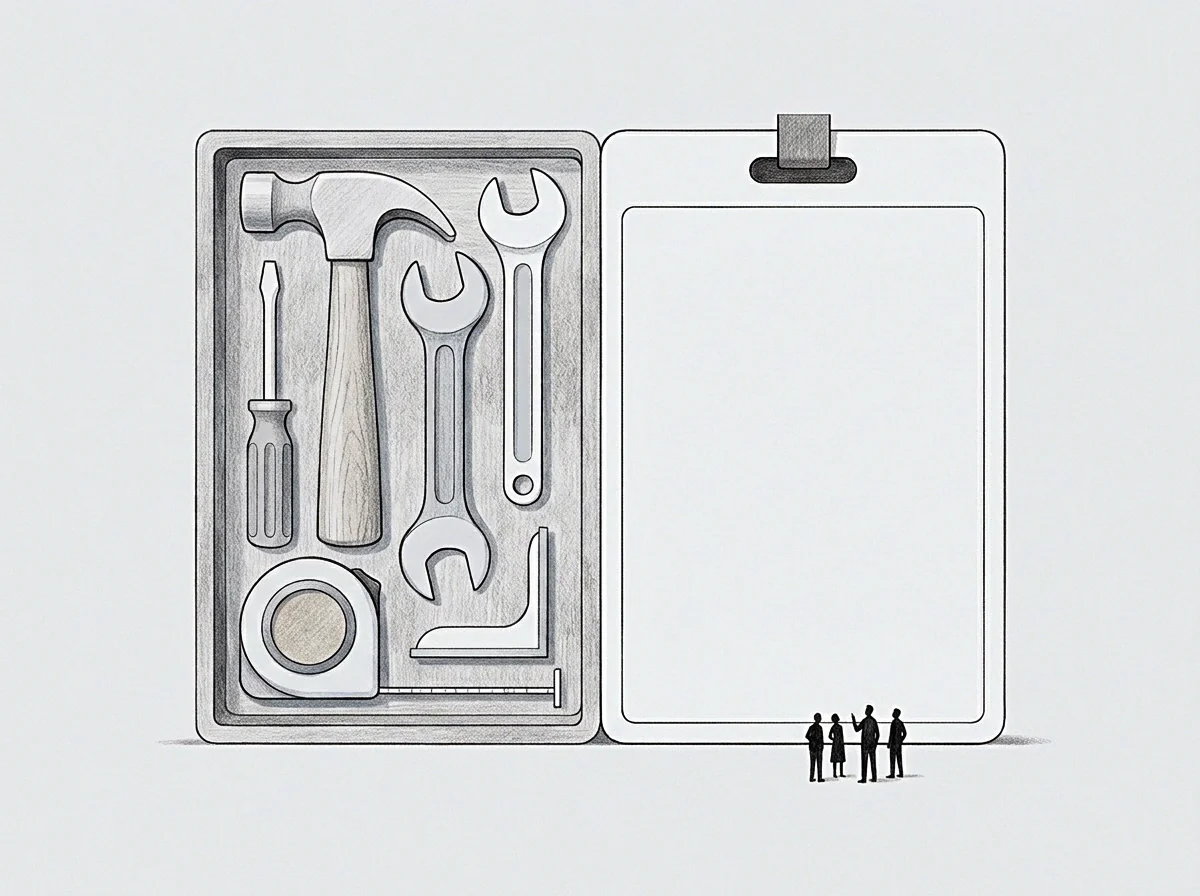
The seat that fronts goes into a client meeting on a subject that is entirely the producer’s craft. The one question that seat can put in that room is what the paper should say and what the terms would be. Asked to me, in a meeting I ran, on work I had done.
Afterwards the report is that it went well, the client is happy, everyone is moving to next steps. Sitting in the room gets mistaken for doing the work, and the mistake is what gets paid. Nobody has to lie anywhere in that chain for it to end at half.
What Leaves a Mark
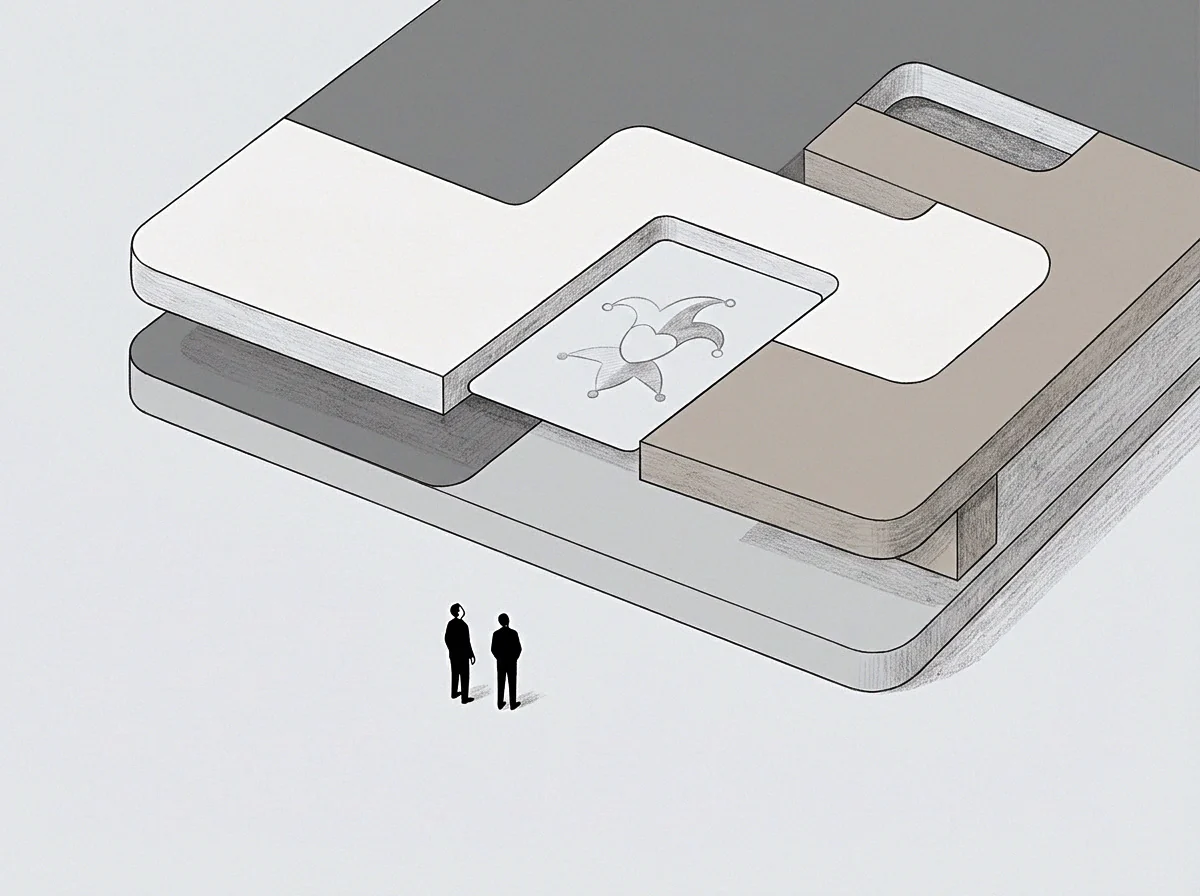
A new client shows up as a transaction: a day it happened, a name against the day, a figure next to the name, something anyone in the unit could point to, the fronting seat included. My side of it shows up as nothing going wrong. The value arrives as a quiet week, and nobody points at a quiet week.
A transaction leaves a record and a non-event leaves none, so every unit built this way pays the one who acquires and underpays the one who prevents, and no one on either side has to decide that for it to happen. What leaves a mark gets paid. What leaves no mark does not, whatever the two seats are called.
That is the shape of the seat, not a fault in one pair of eyes, and the one who prevents cannot see the prevention either, because from inside it feels like the job, and the job does not feel like an asset to the one doing it.
That is the part that cuts at me. I accepted half for a long time, and the reason sits inside the same mechanism, not outside it: my own week never generated a transaction either, so I filed it exactly the way the fronting seat did, as nothing worth counting.
One purchase can carry the whole distortion. A gift bought out of a fee that was already split is paid for, in part, with money the producer earned, and it enters the count as the other seat’s generosity. Nobody means it that way.
It sits there as evidence of support. One rule follows from it: money that already passed through the split cannot also be counted as new generosity, however it gets logged at the moment it lands.

Market
The check is simple and I did it late. I put the arrangement next to what the market pays anyone whose whole contribution is to arrange access to somebody else’s capability.
- Literary agents: around a sixth of what the book earns.
- Talent agents: a tenth to a fifth.
- Recruiters: between a sixth and a quarter of a first year’s pay.
- Speaking bureaus: a fifth to a quarter of the fee.
- Sales representation: from a twentieth up to a fifth.
Nowhere on that list is half.
Half appears in one shape only, whatever the trade: both sides make the thing.
A representative supplies the opening. The market prices an opening at a tenth to a fifth of what it opens, and the rest goes to the one who produces, because without production there is nothing behind the opening to sell. The market is not being hard on introducers.
It is saying what an introduction is: the way into a room, not what happens inside it. Whoever supplies only the introduction is paid like an introducer, whatever the arrangement was called at the start.
Entry
The question I could not answer for a long time was how an arrangement this far off the market rate runs inside a seat like this without anyone in it raising it. The answer I arrived at is not about the seat that fronts. It is about what pricing does inside a system, and I went through four bodies of work to get there.
Social exchange theory is the sociologists’ theory of why people keep dealing with each other. George Homans set it out in 1958, treating a relationship as a run of exchanges in which each side gives something and takes something and keeps going only while the two stay in some visible proportion. Peter Blau built it out in 1964 into a theory of how unequal exchanges produce power, because the side that gives more than it gets, and cannot get out, ends up owing.
The field’s word for the proportion holding is reciprocity, and the point that matters here is a condition on it. Reciprocity is maintained only where both sides can see the ratio. Where one side’s contribution is counted and the other’s is not, there is no ratio to see, and the exchange goes on being called even because nothing in it can be compared.
Chris Argyris, at Harvard, spent decades on why capable people in organisations do not learn what is in front of them. The work on organisational defences, the 1990 book in particular, showed that every unit carries matters that cannot be raised, that the fact of their being unraisable cannot be raised either, and that the people involved run what Argyris called defensive routines to keep it that way while everyone feels reasonable. The matters themselves Argyris called undiscussables.
I take something narrower from Argyris than the theory. Between one seat’s not delivering and the other’s pulling back there is a link, and that link is not hidden from the seat not delivering; it is structurally outside its line of sight, from where it sits. Keeping half of what another person’s capability sells for, for years, without once asking whether the number is right, is a choice made by doing nothing, and it only shows itself as a choice once the true answer would cost something.
That is the undiscussable running inside one seat’s own count of what it owes.
Two smaller findings sit next to it. Richard Thaler named the endowment effect in 1980, and with Kahneman and Knetsch showed it in 1990 with a plain experiment: give people a mug, and they will not sell it for what people without a mug will pay for one. A thing already held is weighed higher than the same thing bought, and the reason is that possession carries no price; nobody paid for what is already in hand.
And Bluma Zeigarnik, in 1927, watched waiters who could recall every unpaid order and nothing of the paid ones: a task left open occupies capacity long after a closed one is gone, because nothing has marked it settled. In each of these a thing with no price attached is not weighed at all. It either vanishes or it never stops running.
Nothing without an entry gets weighed.
That is a mechanism, not a figure of speech. The seat that fronts had its contribution priced from the first day: an introduction produces a transaction, a transaction has a figure, and a figure is an entry. Mine was not.
Delivery produces no transaction of its own, so it never got an entry, and a split cannot weigh what was never logged in the first place. The split read as even for a plain reason: one side had a price and the other side was not on the page, and nobody can see that a comparison is off when only one of the two things is there to compare. For a long time, raising what the work was costing me went nowhere, every time, because there was no figure on the page to set beside the one the fronting seat had, and that was as true from where I stood as from where it stood.
It cost me the sentence I had held for a long time, that nothing wrong had been done. The sentence that replaced it is longer and less comfortable. Nothing malicious was done.
Nobody checked the number, and the arrangement depended on nobody checking it. Intent and effect come apart here, and an arrangement can be extractive with no intent anywhere in it.

Price
A complementary asset carries one price tag, and it is readable only once the asset is gone. The seat that fronts had, for a long time, no occasion to see what delivery was worth, because delivery was not on the table as something that could stop.
Then it was.
If you leave, this does not survive.
That sentence was not new information. The value had been there the whole time. What was new was that it could be seen, because removal was on the table for the first time, and a complementary asset is priced only at removal.
A warning about leaving can only land on someone who has already pictured what leaving would take away, and until removal was on the table, nobody had reason to picture it.
I wrote the restructure as paper and terms. Not an appeal.
I wrote a new number into the draft, a number at the low end of what an introduction earns, for an introduction made a long time ago, and it was the share getting a price for the first time. Neither seat had ever priced it. The number was not a penalty.
It was the rate.
The term that changes everything fits on one line: representation is paid on what it opens, at the rate representation is paid, with an expiry written on both sides. Everything above that rate is production, and production is paid to whoever produced it.