
The missing owner
Someone who only operates has a vacant seat above him: no party to set the terms, price the hours, or decide what the work is worth. That is why nothing ever collects from him, and why the hours he means to give his own work stay theoretical.

Operator
The requests come in and they get answered. Somebody needs a thing, the thing gets made at a standard its maker would defend in a room, it goes out, and the day closes on other people’s work being finished. By the only measure anybody applied to it, that is a good day.
The operator is not lazy.
Nothing in that day was mishandled either. Every hour went where it was asked to go, at speed, and the party who asked got more than they had reason to expect. That is exactly why nobody looks any further.

What Nobody Charged the Operator For
Look at the same day from above and something is missing out of it. Nobody set the terms before the work started. Nobody put a price on the hours it took.
Whether the tools and the systems the whole thing runs on get a morning this month was a question nobody upstairs was there to ask, so it went unasked, the way it went unasked the month before that. The operator ran. Above him the seat that would have done any of that was vacant, and a vacant seat makes no sound, so the day felt fine.
With that seat empty, an hour of the operator’s leaves the building with no price on it and gets its number later, from the party that wanted it, and the number that comes back is the going rate for being available. Supply nobody prices does not read as supply. It reads as nothing, on his side and on theirs, so it keeps being asked for, and nothing above him collects.
A week of that leaves no trace anywhere except in the things that did not get made.
Somebody set the terms of those hours and somebody took the benefit of them, and neither of the two was the operator. Whose day was that?

Owner
The hole in that day is a party. Somebody has to be sitting in the seat above the operator, carrying functions of his own and a week of work to do them in, and nobody is. Install that party and the operation splits in two.
The operator delivers. The owner does everything delivery never touches:
- Before any work starts, the owner says what it is and what counts as done. Not after it has gone wrong.
- He says what an hour is worth before it goes out the door, so it does not come back later with somebody else’s number on it.
- He rations the week: how much of it each kind of work is allowed to take, decided in advance.
- He decides what gets built. And what stays unbuilt.
- He keeps the tools and the systems running, which means they get a morning, because somebody upstairs put that morning in the week and held it there.
Every one of those functions is vacant, and vacant is not the same as badly done. There is no bad performance here for anybody to correct. There is an empty chair, and effort does not fill a chair.
It is also why the care frame never held here: it puts the operator on both sides of the same arrangement, the one delivering and the one being delivered to, and an arrangement with one party in it is not an arrangement. The owner does not sit on the receiving side at all. He is a function carrying obligations, and a man who has executed every role ever handed to him will execute that one too, the day it exists as a role and not as a mood.
There is a reason the seat stays vacant in people perfectly capable of sitting in it, and it is not weak will. Other people’s needs arrive as requests. A person’s own arrive as states.
A request is bounded and answerable and it carries a completion condition inside it: look at the brief, check the terms, get the thing out by the hour that was named. A state carries none: the systems are old, the week is gone, his own work is not where it should be. An operator runs on completable inputs, because that is what an operator is, so the request goes first, every time.
Not because the party asking outranks his own work. Because one of the two inputs arrives in a shape his system can execute and the other one does not. Which is why terms do work that wanting does not: two hours a day, stated by a party, due at a named hour, is a state that has been converted into a request.
Nothing about what he values had to change for it to run.
The same vacancy explains something that reads as generosity from outside. A venture belonging to another party arrives with the founder position already filled, so a builder can go in at full capability and never once sit in the chair where a person has to ask, price, be visible, and say out loud what he is worth. Nobody in that is failing to value himself.
It is a working route around an operation he stopped being able to perform, and it is elegant, which is what makes it last. Everything built that way settles onto somebody else’s position, and it stays there after he goes.
Take the owner out and the operator does not stop, and that is the trap in it. He keeps delivering at the same standard, and everything around him quietly rearranges itself to the fact that nobody is holding a line. Availability goes to whatever is asked, because the seat that would have said how much is empty.
The price of an hour settles at whatever the asking party had in mind, because no party above is stating one. Maintenance is not delivery, and only delivery arrives as a request, so the systems underneath get older while everybody is busy. And the operator, watching his own things not get made, reads a structural vacancy as a defect in his character, calls it a discipline problem, and goes looking for a better morning.
I did that for years. It is like sending the man on the floor to fix the fact that the office upstairs was never staffed.
The owner is a function with a chair under it, and the chair is the part everybody skips. It is easy to agree that a person should think like an owner. Almost nobody puts a half hour in the week where the owner sits down and states something.
Whether he exists has one test: is there a sentence in which the terms of the week got stated, and was there a party stating them who was not the party asking for the work. Where both parties are in the room, the operator can go fast, and fast is safe, because the shape of the week was set by somebody whose job that was. Where one of them is missing, speed only moves the cost forward, and it lands later, in the part of the week nobody was holding.
The output will not tell anybody which of the two it is. For a stretch a man with no owner out-delivers a man with one, and that is what keeps the vacancy invisible from outside, and from inside as well. Where nobody was in the room when the terms got set, there is no owner, whatever the work looked like.
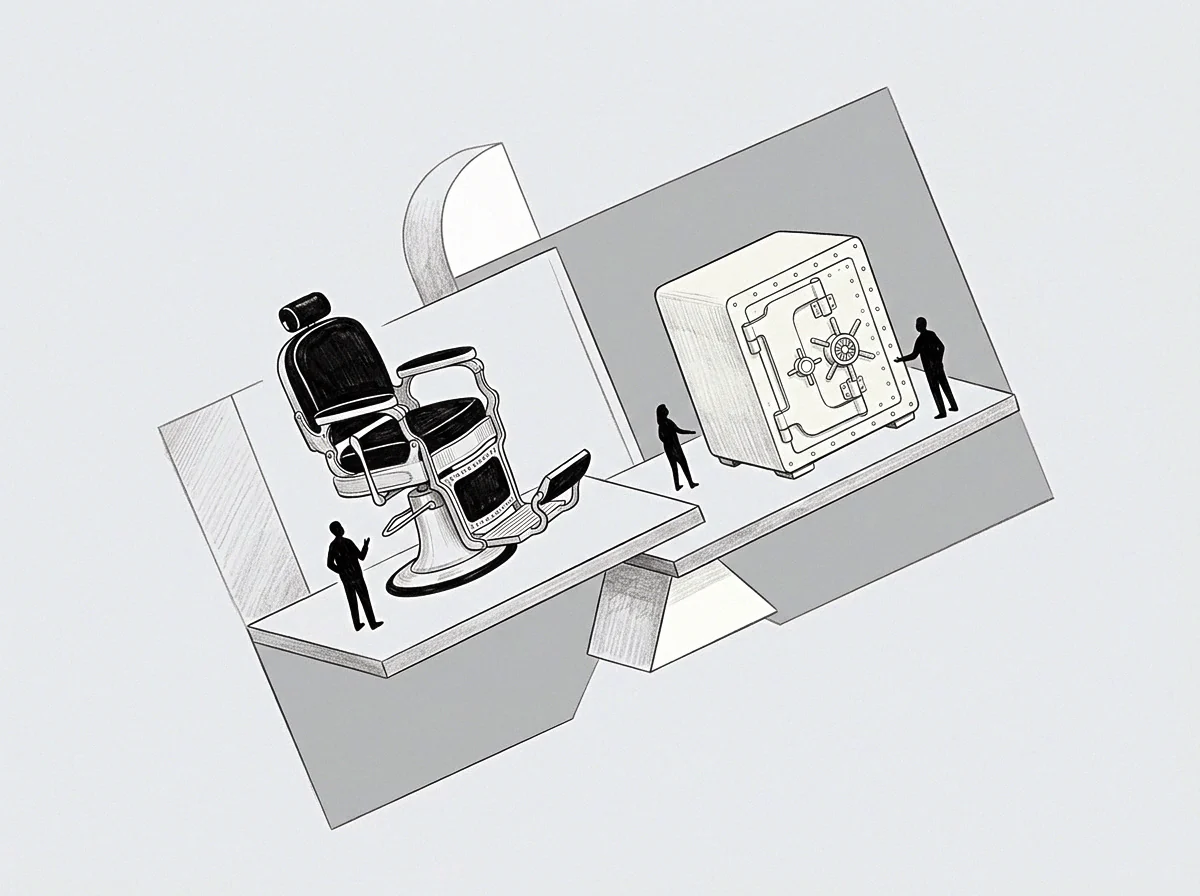
Terms
Somebody has to be standing there at the hour, or the hour does not hold. That is what carries the two hours a day I put on my own work, and nothing else carries them. Held by discipline, nobody is standing there: the hour comes, whatever is loudest in the week takes it, and afterwards no party went short and no stated thing failed to arrive.
Held as a term between two parties, somebody is standing there, a thing was due at a named hour, and the shortfall lands on a party who can name it. The difference is not in how badly I want my own work. It is in whether a second party exists at the hour.
So I stopped calling those hours discipline. They are owed upward now, to the party that set them, and when they slip there is somebody who goes short and can say by how much. I deliver against terms all day for other people.
These ones just have my own name at the top.
The owner writes the sequencing too, and the sequencing is not now. The paperwork with a deadline somebody else set comes first, because that kind of deadline does not move, and the days already promised to other people come after it for the same reason, that they were promised. The two hours start once those are behind me.
A structure installed while what was already promised is still live does not get a fair run, it fails on the traffic and not on the design, and the failure gets read afterwards as evidence that the whole model does not work. I would rather put the hours in a week that can hold them.
And the first of those hours do not go to the work at all. They go to its terms: what it is, what it is worth, what it is allowed to cost, who decides when that changes. The queue empties first and the seat gets filled after, in that order, because the operator cannot be in two places.
He is not going to enjoy that morning. He has been running a long time and running is what he is good at.