
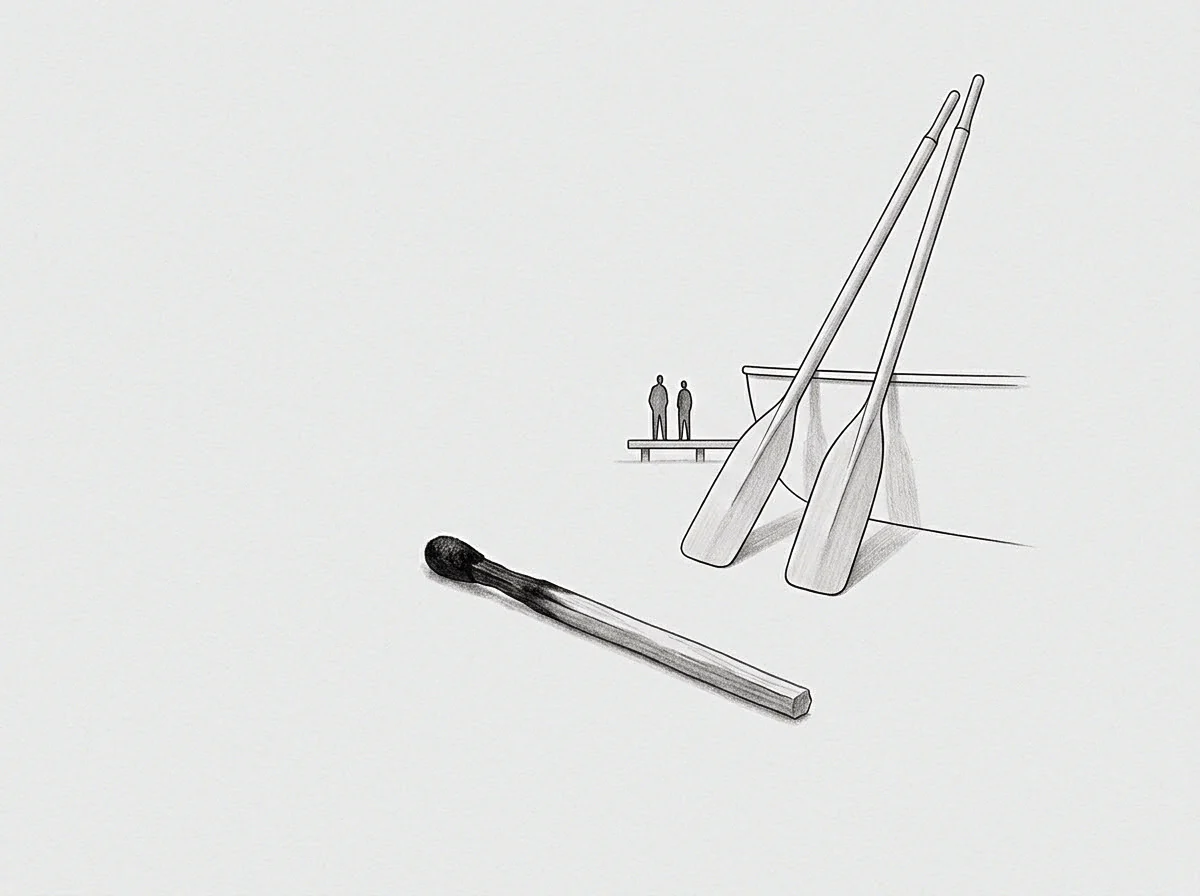
Waiting has a price and it is not zero
Delay on something you can undo and delay on something you cannot look identical from outside, and they are not the same act. One is a queue. The other is a position somebody is holding, and it gets worth more
A founder holds a right, but not an obligation, to take a specified future action under predetermined conditions. This option-holding grants flexibility in uncertain environments by allowing a deferral of commitment until more information becomes available or specific events occur. It governs a future action or inaction, providing the latitude to adapt to changing circumstances rather than being bound by an immediate, irrevocable choice.
The value of this position is derived from the ability to act on favorable outcomes while avoiding commitment to unfavorable ones. This mechanism ceases to apply once the decision window closes, the option is exercised, or its underlying conditions fundamentally change, defining a clear boundary between present capacity and future action.
Maintaining a decision point as an option creates a strategic delay within a work process, allowing for flexibility in navigating complex situations. This mechanism enables a founder to observe evolving market conditions, customer responses, or technological advancements before making irreversible commitments of time or capital. The process operates by setting a specific trigger for future action, which could be a market signal, a regulatory change, or a product milestone, allowing continuous data collection and analysis to occur in the interim.
The benefit of option-holding is directly tied to the rate of information acquisition; the more critical data points that emerge during the delay, the better informed and lower-risk the eventual decision can be for the operating person. This approach is distinct from simple procrastination, as it involves active monitoring and the conscious preservation of future choice, often through preliminary investments or ongoing effort to keep the option viable. The strategic purpose is to reduce downside risk by avoiding premature resource allocation while preserving the potential for upside gain, a deliberate deferral distinct from a passive queue.
It provides a structured way to manage uncertainty, allowing a more precise deployment of resources when the future state becomes clearer.
Sustaining an option position always imposes a cost burden on the founder, even when no explicit monetary fee is involved. This cost frequently takes the form of a drain on attention, requiring ongoing mental capacity to track conditions and assess the option’s evolving value. There is also an opportunity cost, representing alternative actions or investments foregone by keeping the option open.
Material costs can include expenditures for maintaining intellectual property rights, holding market access, or retaining staff who are not yet fully deployed, reflecting real-world outlays. This burden ensures that an option is not a free good but a resource that requires active management and periodic re-evaluation to justify its continued existence and strategic purpose.
The inherent value of option-holding tends to increase as uncertainty about future states remains high and resolution approaches, particularly concerning market reception or technological success. This accrual stems from the optionality itself, providing the holder with the right to capture favorable outcomes while mitigating exposure to unfavorable ones, a core benefit of maintaining flexibility. For a founder, an option’s worth grows with the unpredictability of external factors, such as nascent market demand or unproven technological feasibility, where greater variance enhances its potential upside.
As time passes, the range of potential outcomes may narrow, making the decision point clearer and the optionality more potent by concentrating potential gains. The value generated by option-holding is therefore a function of both the underlying asset’s potential and the degree of unresolved future conditions it hedges against, making it a critical strategic asset in early-stage development. This positional advantage diminishes as clarity increases or the window for action closes.
Delay on something you can undo and delay on something you cannot look identical from outside, and they are not the same act. One is a queue. The other is a position somebody is holding, and it gets worth more
The terms are written where they belong. Each field holds three desks, and every entry a desk writes raises the terms it uses, each term given a meaning, a mechanism and the places it appears. The record on these pages stays first person and hand made; the fields grow the nomenclature.