
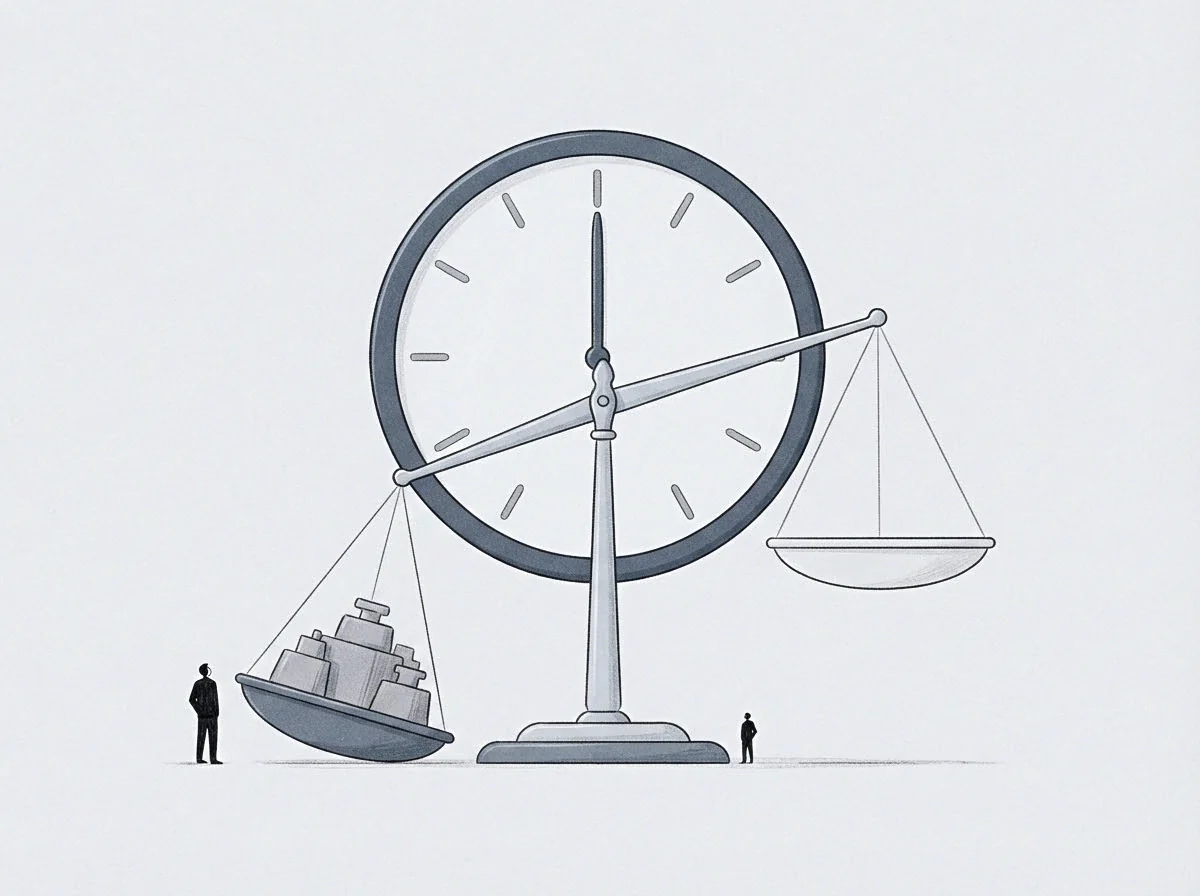
A shelf with a clock on it
A thing I cannot finish stops costing me once whatever can happen next on it, down to nothing happening at all, has an answer written down outside my head. Then a project can sit on a shelf, frozen and still
A characteristic of paused work describes its capacity to be restarted with minimal additional investment. This inherent quality, known as resumption tendency, identifies the degree to which a stalled project or task can be set aside without continuing to consume a founder’s attention, mental energy, or active operational resources. It measures the effectiveness of documenting a project’s current state, its outstanding questions, and its external dependencies such that its reactivation requires no internal effort until a specific condition is met.
This principle applies when the path to recommencement, or formal termination, is clearly articulated and external to the founder’s ongoing work, ensuring the project becomes dormant rather than a persistent drain. The tendency diminishes when the required information for restart is internal, implicit, or incomplete, demanding internal review or re-scoping upon potential reactivation, increasing the founder’s cost.
This quality directly mitigates the unseen costs associated with unfinished work. A founder gains significant operational capacity by ensuring that projects with a high resumption tendency do not retain a hidden load of mental energy or decision-making cycles, nor do they occupy valuable active pipeline slots or resource allocations. The work shifts from an active problem that demands internal processing to a dormant asset recorded on the project shelf, waiting for an external signal from a counterparty or a market event.
The cost saving is directly proportional to the clarity of the project’s next state and the meticulous documentation of its prior progress, which frees the founder to allocate scarce personal and operational resources to active tasks without the constant burden of stalled initiatives. This approach prevents the common scenario where an incomplete item continues to demand intermittent internal checks, unresolved queries from other internal operators, or the tracking of minor internal sub-dependencies, even while formally paused. Without this structured clarity, a founder pays an ongoing attention cost, depleting capacity and detracting from the focus on current operations and core work.
The cost compounds over time as the context fades and the effort to re-engage increases.
The ability to resume work effectively depends entirely on specific, pre-defined conditions being met. A project configured for high resumption tendency has its internal state fully resolved, with all internal questions answered, and its next step conditional solely on an external action or input. This clarity means the project can remain dormant indefinitely without requiring internal re-evaluation of its status or progress from the founder’s seat.
An external seat, such as a partner, a client, a regulatory body, or even a specific market condition, typically holds the trigger for reactivation, whether it is a decision, a resource allocation, a market event, or the provision of specific data. Preparation for this involves meticulously recording the exact state of work at the point of pause, identifying the specific information needed for restart, and naming the party whose action will prompt a restart, often including contact information or a clear communication protocol. Such detailed preparation allows the founder to simply monitor for the external signal rather than actively managing the stalled project, transforming a potential internal drain into a clear, externally-governed dependency.
This shifts the load of initiating action away from the founder, preserving their capacity for active work.
The concept of resumption tendency holds only when a project’s suspension is truly passive and external to the founder’s active work, making no claims on their attention or resources. Its utility ceases if the founder must periodically reassess the project’s viability, track internal minor dependencies, or provide ongoing low-level support, such as answering ad-hoc queries about its status from other internal parties or performing routine maintenance. Any requirement for internal effort, even minimal, indicates a breakdown in the project’s dormant state and thus a low resumption tendency.
This boundary separates work that genuinely sits on the shelf, drawing no internal cost in terms of time or cognitive load, from work that remains a low-grade, persistent operational demand. The benefit of containing a project’s cost disappears entirely if its status demands frequent internal check-ins, necessitates minor adjustments to plans or scope, or requires resource allocation from within the founder’s active work, transforming it back into an active task, albeit one with slow or uncertain progress. A founder operating close to this boundary pays a high cost in fragmented attention and diluted focus.
A thing I cannot finish stops costing me once whatever can happen next on it, down to nothing happening at all, has an answer written down outside my head. Then a project can sit on a shelf, frozen and still
The terms are written where they belong. Each field holds three desks, and every entry a desk writes raises the terms it uses, each term given a meaning, a mechanism and the places it appears. The record on these pages stays first person and hand made; the fields grow the nomenclature.