
Succession is a will, not an exit
The same clause reads two ways, and which way it reads is set by how much of the paper is spent on the ending, not by the wording of any one line. Mine was spent almost entirely there, it came back called an exit plan written in bad faith, and what finally went on the table was one page.
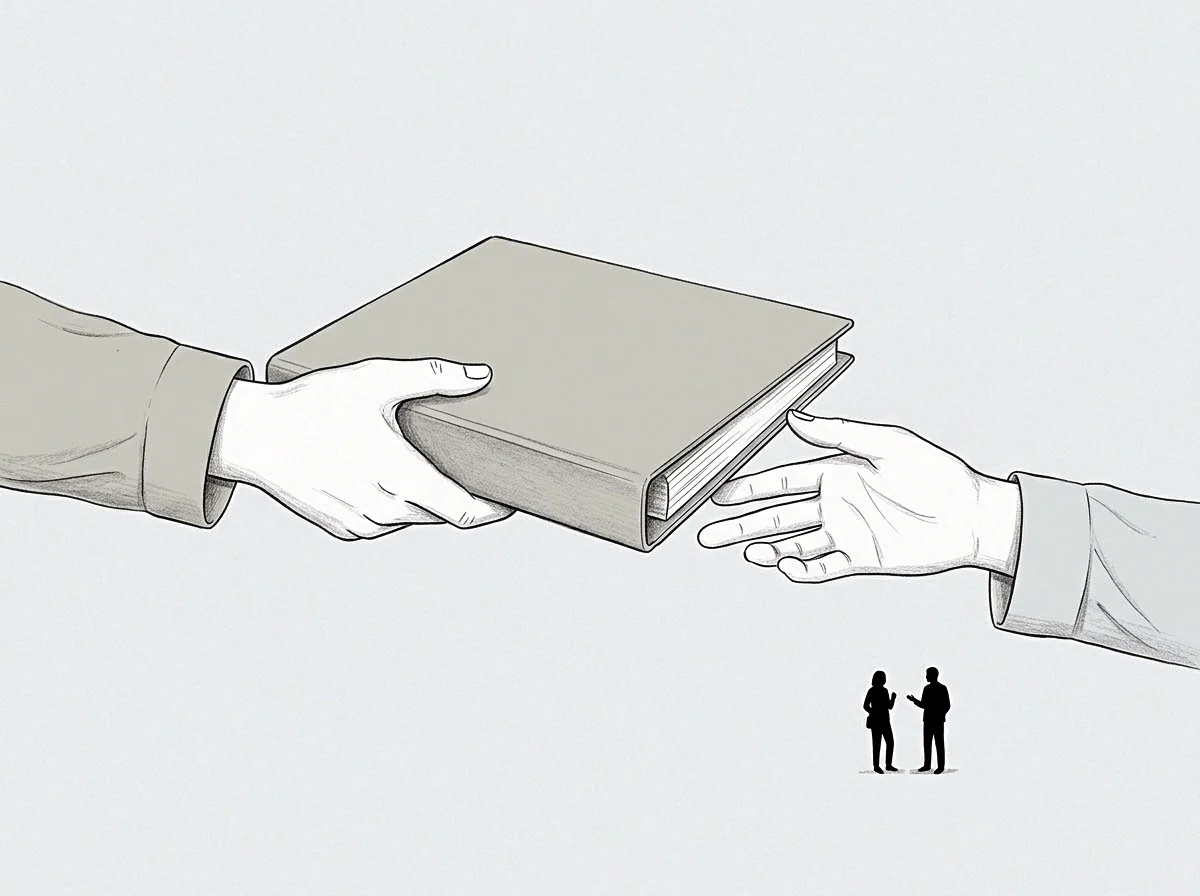
Succession
A partnership document is not read line by line, not the first time. The person opening it takes the weight first: how much is about the thing running and how much is about the thing stopping. That share sets the reading inside the first half second, and every condition underneath arrives already coloured by it.
The conditions never get their own hearing.
A reader counts the pages about ending before he reads a single term.
One clause carries most of that weight. It says what happens to the thing when one of the two stops being in it: who takes the work, who takes the holding, what the other side gets and on what terms. Read as an exit, that clause protects one member of the pair from the other.
It answers a question with a leaver inside it, and the leaver a man imagines is whoever put the paper on the table. He is not reading the terms. He is reading the fact that somebody sat down one evening and thought about not being here.
Read as succession, the same clause protects the thing from an accident. Illness. A visa refused.
A family emergency in a country neither party is standing in. Death. Not one of those has a decision inside it, so not one of them puts a man in the room who is planning to go.
Nobody has ever taken a will for a way out of a marriage.
All of it can be made to sit on one word, and the word is cannot. Leaves and cannot continue set off the identical machinery: the same successors, the same holding moving to the same place, the same terms worked out the same way, the same signatures at the bottom. One version says a man chose to go.
The other says a man was taken out of the seat by something that came from outside the arrangement, and the only open question left is who picks up the work the next morning.
I had that wrong for a while, and it took the paper coming back to show me. The version I sent out had the armour built in on purpose: what happens on failure, on death, on a partner going quiet, on the thing being converted into something else, every route out priced and closed. Each of those clauses is sound and I would write them again.
But once they were all in, most of the document was about the ending, and a person opening the file cold reads that share and nothing else. What came back was not an argument about a clause. It was that this is an exit plan and not a contract, that it was not made in good faith, and that the whole arrangement should be reset before anything else moves.
None of that is a reading of the succession clause. It is a reading of how much room the ending had been given. So the word cannot is real and it is worth having, and it does not reach a paper whose weight has already spoken.
Will
The will is not a trick, and I want to be careful about that, because a frame that works only while the other side does not notice it is not a frame. It works because of where paper sits inside the model the arrangement is held in. Paper written by one member, about the pair, reads there as decay: somebody has started writing things down, so something has already gone wrong.
There are five places where it does not read that way at all.
I wrote the list out because I wanted to see whether what gets refused is documents in general or this document.
Two of the five have nothing to do with the pair at all. One is a third party arriving. An employee, an investor, a client walks in, the structure becomes about them instead of about us, and the paper stops being a message between two people and turns into plumbing for a third.
The other is size. Once the work is past what handshakes can hold, the document lands as a consequence of the work going well instead of a symptom of it going wrong, and family firms have run on that for generations without anybody inside one calling it betrayal. The remaining three sit closer in, and they are the ones I had to think about.
- An outside requirement. A tax office, a bank, a visa desk, somebody carrying the financial risk who is not me and whose stated need is a clear picture of the money and control of how it is reported. When the paper is demanded from outside, the signal between the two of us goes out of it, and what is left is an entity that has to be legible to whoever is holding its risk. Nobody in the pair is asking anybody for anything.
- Formalisation as commitment. A marriage is a contract and people in this model sign it gladly, because the paper is described as tying a man in rather than cutting him loose.
- Protection of the other, which is the will. Nothing in it asks the other side to hand anything over.
The same contract is a wedding or a divorce, and not one word of it changes.
What makes the frame necessary at all is not a fault in a man. It is a property of an arrangement nobody ever wrote down, and I argued with that property for a long time before I could put a name on it. An arrangement with no stated terms has no place in it where a condition gets met or missed.
Nothing was named, so nothing arrives late and nothing goes undelivered, and there is nothing standing in it to be answered for. What looks from inside like one member holding out on the other is not that. It is absence.
There is no place in the thing to hand anything over from, and no version of asking that reaches it, because the model an arrangement is held in does not change because one member of it asks.
So the document goes where the model can take it. A man signs the paper that binds him in and refuses the identical paper when it is called the way out, and what decides which one it is sits in the thing the paper is said to protect, not in any line of it. For a long time I wrote for a model that was not in the chair, and called the gap between them bad faith.
Dropping that argument bought me nothing warm. It bought one rule, and the rule is that a man who wants a signature writes for the reader he has.
Clause
The frame has a problem sitting on top of it, and the problem arrived with the frame. Bending a document into a shape a partner can hold is work, and the work has a name: translation labour. Producing his participation was the job I actually held for years, and I quit it.
Using the frame means picking that job back up for one more round, to get a signature out of it.
The Narrow Version
The resolution has to stay narrow, or it is the old pattern wearing better words. So the whole of it is two sentences in a message, and the writing is not the hard part. The hard part comes after, where I am not allowed to find out whether it landed.
I am not writing the end of this.
I am writing the morning one of us cannot work, and that morning is not covered, on my side or yours.
That is all of it. They take the ending reading off the table without disputing it, and disputing it would not work anyway, because a reading that lands in the first half second is not reachable by argument. A different half second is the only thing that reaches it.
They put the question on the morning one of us cannot carry the thing, and they say either of us, so there is nothing defensive left in there for the partner to answer. Then they stop. The partner keeps the producing, which is where it has to sit, because the version he writes is the only one that tells me anything.
Two sentences and a silence is the whole of what I have to spend, and I have spent more than that on less.
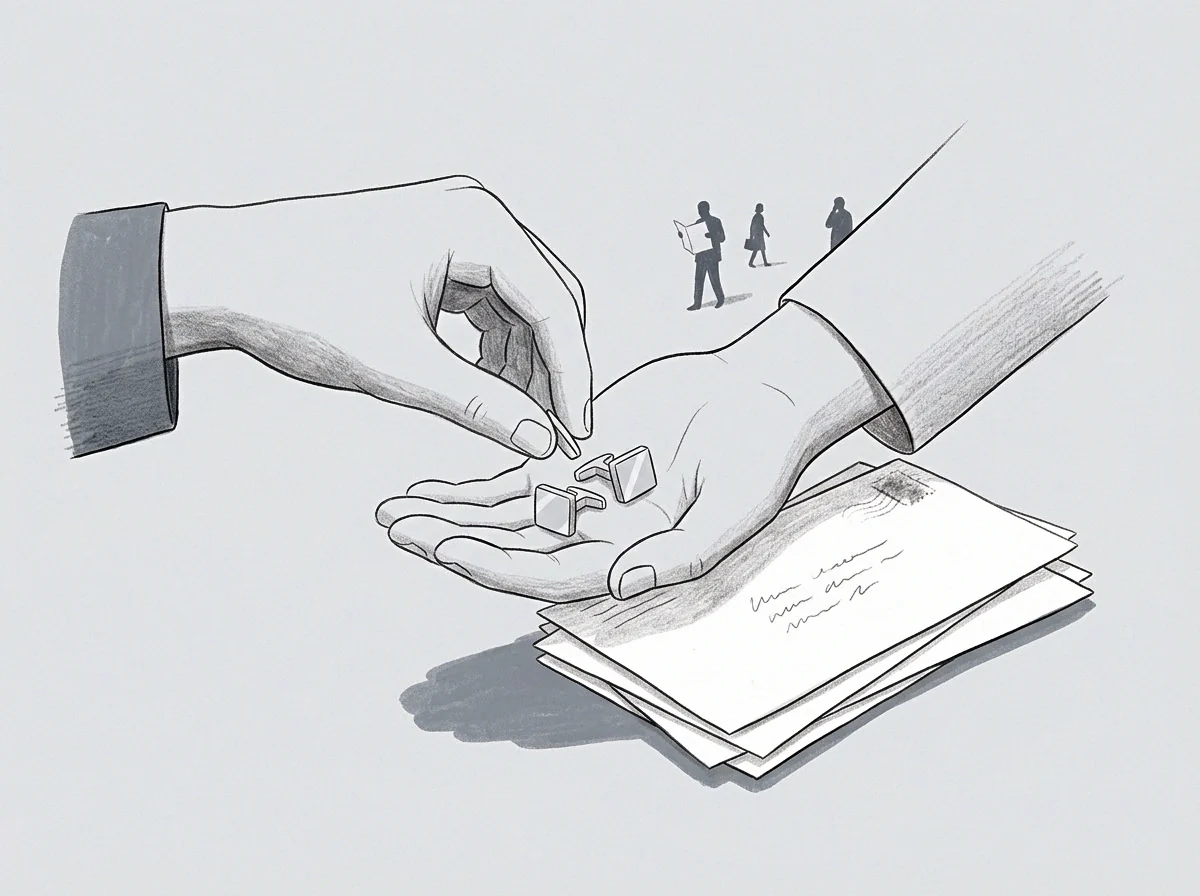
What The Frame Cannot Reach
It does not move the odds much, and I am writing that down so I do not read a small change later as a win. The reframe answers the objection the other side says out loud. The one underneath it does not get touched.
The contract fixes terms, and terms make a thing measurable: what was promised, what arrived, what did not.
The position a man holds inside an unwritten arrangement needs that second half never to exist, because a position with no stated spec cannot be found short of it. So the cost of signing was never the clause and never the wording. The cost is becoming a thing with terms on it.
A better frame changes what the paper is called. It does not change what being answerable costs the man who has to be it.
What the two sentences buy is one clean piece of information. If a partner cannot sign a continuity clause that somebody outside the pair is asking for, then it was not the wording, and I hold that as a fact instead of carrying it any longer as an inference.
Run the offer wide instead of narrow and I pay in the other direction: the explaining, the second message, the call to check the partner understood the frame, the meeting to walk him through it, and I am back producing his participation in better words than last time, having quit the job for nothing.
Names
I found out I already believed this when I read my own draft again. The succession part was written into it, and it named two people, not a class of person, with the functions split between them.
- the one who could keep the engine running, which is a build problem and takes somebody able to hold all of it in his head;
- the one who could hold the money and report on it, a different person and a different kind of nerve.
They went in before I could have said why. Naming them turns the clause into a provision about continuity, and it settles the honesty question, which was the part I was least sure of. I was not writing myself a way out.
Then the other side asked for the whole arrangement to be reset, and I took the reset. Start one from the work outward and the person doing the work is the one it favours. So the long paper stopped being the artifact.
What went on the table instead is one page: who does what, what stays with whoever built it, what gets tracked by the plumbing instead of reported, and what holds until the page is signed. Continuity is in there, at the back, drafted from the page rather than leading it. One sitting to agree the page, then the long document written out of it and read against it.
The two names come off anything that goes on a page, and they become two functions. Neither man is interchangeable.